Introduction
A cutting board is one of the most frequently used surfaces in a kitchen. From preparing vegetables for a weekday dinner to trimming meat, slicing fruit, chopping herbs, or portioning ingredients for meal preparation, the cutting board sits between the food and the kitchen countertop during many everyday cooking tasks.
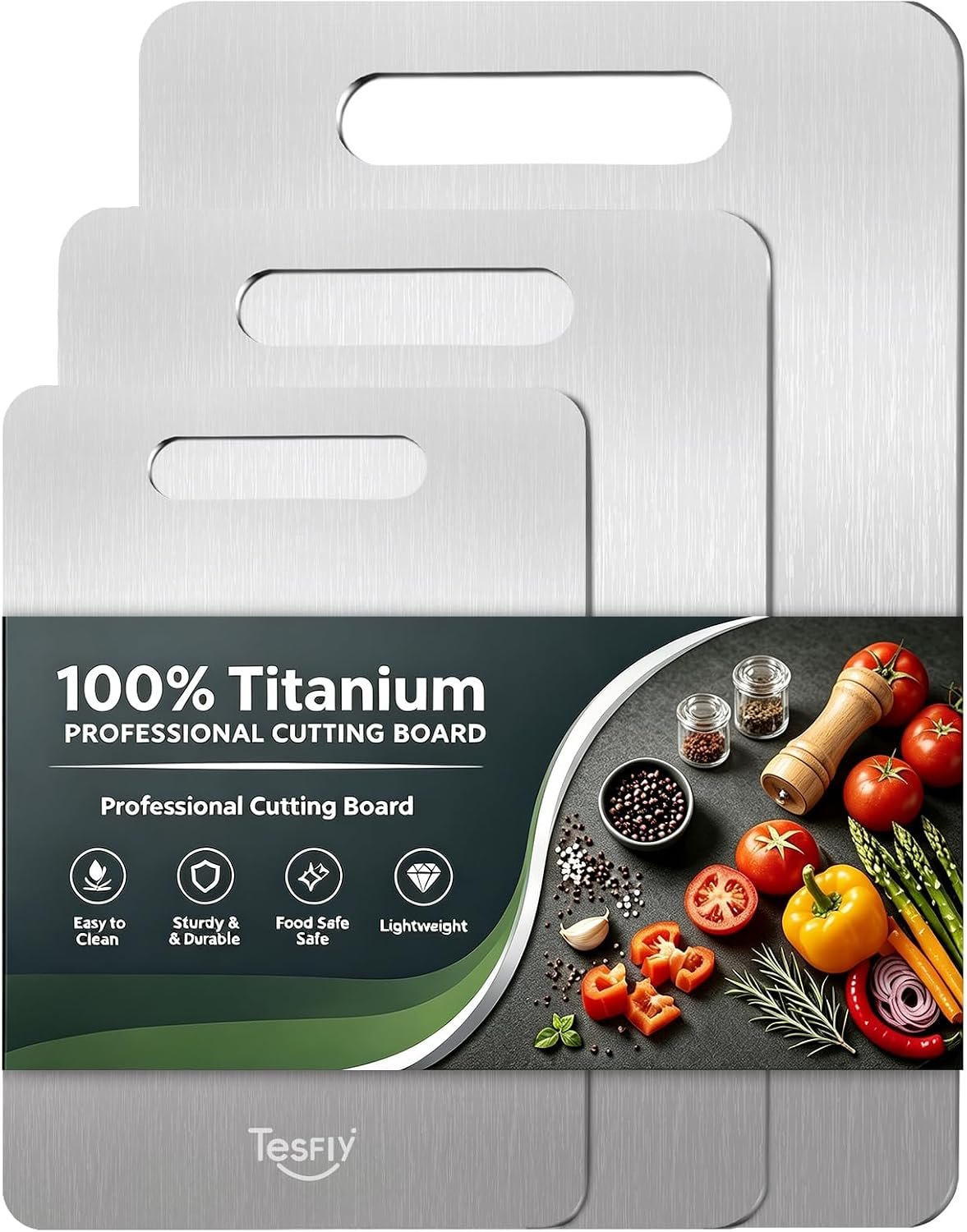
The 3 Pack Titanium Cutting Board Set is designed around a material that differs considerably from the wood, bamboo, plastic, and composite boards commonly found in kitchens. The product is described as a set of three titanium cutting boards in M, L, and XL sizes, with a double-sided design and a food-grade titanium construction. It is also marketed for preparing different types of ingredients, including meats, fruits, and vegetables.
Using several cutting boards rather than one can be helpful for kitchen organization. Different sizes can be assigned to different tasks, while separate boards can help reduce unnecessary contact between raw ingredients and foods that are ready to eat. A larger board provides more working space for substantial ingredients, while a smaller one can be easier to handle for quick preparation.
Titanium also has characteristics that distinguish it from traditional cutting-board materials. It is a metal, so its feel, weight, sound, and interaction with knives can differ from what someone might expect from a wooden or plastic board. Those differences are worth understanding before choosing a titanium cutting surface for regular kitchen use.
The purpose of this guide is to provide practical information about the 3 Pack Titanium Cutting Board Set, its design, possible kitchen applications, the role of the three sizes, food-preparation considerations, cleaning and storage, and how titanium compares with other general cutting-board categories.
This is not a personal product test or a performance rating. Instead, it is an educational overview intended to help readers understand where this type of cutting board may fit into an everyday kitchen.
Understanding the 3-Piece Titanium Cutting Board Set
The product is presented as a three-piece set containing different board sizes:
- Medium
- Large
- Extra Large
Having several sizes can make food preparation more flexible.
A small task does not necessarily require a large board.
At the same time, preparing a whole chicken, several vegetables, or a large quantity of ingredients can be inconvenient on a small cutting surface.
The three-board approach provides different working areas for different situations.
Why Multiple Cutting Boards Can Be Useful
A kitchen can involve many ingredients during a single meal.
For example, preparing dinner might involve:
- Raw chicken
- Carrots
- Onions
- Fresh herbs
- Lemon
- Cooked ingredients
Using different cutting boards can help organize these tasks.
A household might designate one board for raw meat and another for produce.
This can reduce unnecessary cross-contact between ingredients.
Food safety practices still depend on proper washing, hand hygiene, knife cleaning, and cooking temperatures, but separate cutting surfaces can be a useful part of an organized preparation routine.
The Medium Cutting Board
The medium board can be useful for smaller tasks.
Possible applications include:
- Slicing fruit
- Chopping herbs
- Preparing garlic
- Cutting small vegetables
- Portioning cheese
- Slicing lemons
- Preparing garnishes
A smaller board can be easier to move around the kitchen.
Preparing Breakfast Ingredients
A medium cutting board can be convenient for quick morning preparation.
For example:
- Slice bananas
- Cut strawberries
- Chop herbs
- Prepare avocado
- Slice tomatoes
When the task involves only one or two ingredients, a very large board may take up more counter space than necessary.
Preparing Herbs
Fresh herbs often require relatively little working space.
A medium cutting board can provide enough room to:
- Remove stems
- Chop parsley
- Mince cilantro
- Slice basil
- Chop green onions
A sharp, suitable kitchen knife should be used rather than excessive downward force.
The Large Cutting Board
The large board offers more working surface.
This can be useful for:
- Larger vegetables
- Multiple ingredients
- Meat preparation
- Batch cooking
- Meal preparation
- Larger quantities of fruit
A larger surface also provides more room for ingredients to remain organized.
The Extra-Large Cutting Board
The XL board is the largest option in the set.
Extra working space can be particularly useful when preparing larger quantities.
Examples include:
- Whole vegetables
- Multiple chicken breasts
- Larger cuts of meat
- Watermelon
- Cabbage
- Large batches of vegetables
- Meal-prep ingredients
A larger board can reduce the need to move chopped ingredients to another container simply because the original working surface has become crowded.
Cutting Board Size and Kitchen Workflow
Board size affects more than convenience.
Imagine preparing a stir-fry.
You might need:
- Bell peppers
- Onions
- Broccoli
- Carrots
- Garlic
- Chicken
A larger cutting surface gives you room to prepare several ingredients before transferring them to separate bowls.
For meal preparation, this can make the workflow more organized.
Double-Sided Design
The boards are described as double-sided.
A double-sided cutting board provides two usable surfaces.
This can be useful when one side is being used for a particular ingredient and another clean surface is needed.
However, the presence of two sides does not eliminate the need for proper cleaning.
If one side has been used for raw meat, simply flipping the board does not make the board clean.
The board should be cleaned appropriately before the other side is used for food preparation.
Titanium as a Cutting Board Material
Titanium is a metal known for its combination of low density relative to many other metals and resistance to corrosion.
In a kitchen cutting board, titanium creates a very different surface from:
- Wood
- Bamboo
- Plastic
- Silicone
- Composite materials
The material choice affects cleaning, handling, knife interaction, appearance, and overall kitchen experience.
What “Food-Grade Titanium” Means
The product is described as using food-grade titanium.
When evaluating any food-contact product, it is important to distinguish the material description from broader assumptions about safety.
“Food-grade” generally indicates that the material is intended for food-contact applications under specified conditions.
Users should still follow the manufacturer’s instructions for:
- Cleaning
- Temperature exposure
- Storage
- Food contact
- Maintenance
Corrosion Resistance
Titanium is known for its corrosion resistance.
This characteristic can be useful in kitchen environments where surfaces regularly encounter:
- Water
- Food juices
- Acids
- Salt
- Cleaning agents
However, corrosion resistance does not mean a product should be exposed indefinitely to every chemical or cleaning method.
Use the manufacturer’s care instructions.
Cutting Meat
A cutting board needs to provide enough space for safe and controlled food preparation.
The large and XL boards can be useful when preparing meat.
Possible applications include:
- Chicken
- Beef
- Pork
- Turkey
- Fish
Raw meat should always be handled carefully.
Use a separate preparation surface when practical, and clean the board thoroughly after use.
Raw Chicken Preparation
Chicken can release juices during preparation.
A dedicated cutting board can help separate raw poultry preparation from other food preparation tasks.
After cutting chicken:
- Remove scraps.
- Wash the cutting surface according to the manufacturer’s instructions.
- Clean the knife.
- Wash hands thoroughly.
- Clean surrounding surfaces as necessary.
Do not prepare ready-to-eat food on a contaminated surface.
Preparing Beef
The larger boards can provide room for:
- Steaks
- Roasts
- Ground-beef preparation
- Portioning larger cuts
A large working surface can make it easier to control the food and keep ingredients organized.
Preparing Fish
Fish can be delicate.
A stable cutting surface helps when:
- Filleting
- Portioning
- Removing skin
- Cutting into pieces
Clean the board thoroughly after raw fish preparation.
Cutting Vegetables
Vegetables are among the most common cutting-board applications.
Examples include:
- Potatoes
- Carrots
- Onions
- Peppers
- Cucumbers
- Zucchini
- Tomatoes
- Broccoli
- Cabbage
A large board can be particularly useful for batch vegetable preparation.
Preparing Fruit
Fruit can be prepared on a clean cutting surface.
Examples include:
- Apples
- Pears
- Melons
- Pineapple
- Strawberries
- Mangoes
- Oranges
Large fruits such as watermelon benefit from a larger work area.
Cutting Watermelon
A large or extra-large board can provide the space needed for a watermelon.
A practical process is:
- Wash the outside of the fruit.
- Stabilize it carefully.
- Trim the ends.
- Cut the watermelon into manageable sections.
- Slice or cube the flesh.
A large board can help contain juice and provide room for the fruit.
Preparing Pineapple
Pineapple requires several cuts.
A large board provides more room to remove:
- Top
- Bottom
- Outer skin
- Core
The extra space can make the preparation process more organized.
Meal Preparation
Multiple boards can be useful during weekly meal preparation.
For example:
Medium: Herbs and garnishes.
Large: Vegetables.
XL: Meat or large ingredients.
This allows several ingredients to be prepared simultaneously.
Separate Boards for Different Foods
Some households use a board specifically for raw meat and another for produce.
This can simplify kitchen organization.
The three-board set gives you enough surfaces to establish such a system if the board sizes work for your kitchen.
Cross-Contact Considerations
Using different boards does not replace proper sanitation.
For example, if a board is used for raw chicken, it should be cleaned thoroughly before being used for salad ingredients.
Do not assume that using the other side of the same board is sufficient.
The important principle is that the food-contact surface should be clean and suitable for the next ingredient.
Knife Interaction
One of the most important considerations with a metal cutting board is how the surface interacts with knives.
Titanium is substantially harder than many traditional cutting-board materials.
That means knife behavior may feel different compared with cutting on:
- Wood
- Bamboo
- Plastic
The exact effect depends on the knife steel, blade geometry, sharpening condition, and the cutting technique being used.
Knife Edge Maintenance
Knife edges can be affected by the cutting surface.
People who place a high priority on maintaining finely sharpened kitchen knives may want to consider how a titanium cutting board fits into their overall kitchen setup.
A metal cutting surface can produce a different sensation and sound from a softer board.
If preserving a particular knife edge is a major priority, a softer cutting-board material may be worth considering for some tasks.
Knife Technique
Avoid excessive force.
A properly sharpened knife should generally cut through food without requiring extreme downward pressure.
Use controlled movements.
Do not use the knife as a scraper unless the manufacturer specifically indicates that the board is suitable for that use.
Chopping Herbs
For herbs and small vegetables, controlled knife movements are preferable to aggressive chopping.
A medium board provides enough space for these tasks without requiring a large countertop footprint.
Dicing Vegetables
When dicing vegetables:
- Cut the ingredient into manageable pieces.
- Create a stable flat surface.
- Hold the food securely.
- Keep fingers away from the blade path.
- Use controlled cuts.
The board’s surface should remain stable during the process.
Cutting Meat Safely
Large pieces of meat can move during cutting.
Use an adequately sized board.
The XL board may provide additional room to position larger cuts without having them hang over the edges.
Cleaning Titanium Cutting Boards
Cleaning is one of the most important parts of cutting-board maintenance.
Because titanium is a non-porous metal surface, it does not behave like porous wood.
However, food residue can still remain on the surface.
The board should be cleaned after each use.
Why Prompt Cleaning Matters
Food residues can include:
- Meat juices
- Fat
- Fruit sugars
- Vegetable residue
- Starches
- Sauces
Cleaning promptly prevents residue from drying onto the surface.
Cleaning After Raw Meat
After preparing raw meat:
- Remove visible food residue.
- Wash the board according to the manufacturer’s instructions.
- Rinse appropriately.
- Dry thoroughly.
- Clean the surrounding work area.
- Wash your hands.
Use appropriate food-safety practices throughout the process.
Cleaning After Fruit
Fruit may leave sugary or acidic residue.
Examples include:
- Citrus juice
- Watermelon juice
- Pineapple juice
- Berry stains
Clean the surface after preparation.
Cleaning After Vegetables
Vegetable residue is generally easy to remove when fresh.
However, starches from potatoes and other ingredients can dry onto a surface if left unattended.
Drying the Board
After cleaning, allow the board to dry properly.
A dry surface is easier to store.
Avoid placing a wet board into a closed cabinet or tightly enclosed space.
Dishwasher Considerations
Do not automatically assume that a metal cutting board is dishwasher safe.
Even if titanium itself tolerates certain conditions, the complete product may include design features or components with separate care requirements.
Check the manufacturer’s instructions before placing the board in a dishwasher.
Avoiding Harsh Chemicals
Titanium has strong corrosion resistance, but that does not mean every cleaning chemical is appropriate.
Follow the manufacturer’s recommendations.
For routine food preparation, use an appropriate cleaning method rather than unnecessarily aggressive chemicals.
Odor Considerations
Food odors can remain on some cutting-board surfaces.
A non-porous metal surface may behave differently from porous wood.
Nevertheless, garlic, onions, fish, and other strongly scented ingredients should be cleaned promptly.
Storage of Three Boards
Three boards require more storage space than one.
The advantage is flexibility, but the trade-off is organization.
Possible storage approaches include:
- Vertical storage
- Cabinet storage
- Wall storage
- Dedicated cutting-board rack
Make sure the boards can dry completely before storage.
Organizing by Size
One simple system is:
Medium: Daily small tasks.
Large: Vegetables and regular meal preparation.
XL: Meat and larger ingredients.
This can make it easier to select the appropriate board quickly.
Kitchen Counter Space
The XL board may require significant counter space.
Before using it, check that there is enough room to position it safely.
Do not place a large cutting board so close to the counter edge that it becomes unstable.
Weight and Handling
Titanium is relatively lightweight for a metal compared with some other metals, but the actual weight of a cutting board depends on its thickness and construction.
Larger boards will naturally be more substantial than smaller ones.
Consider whether you can comfortably move and wash the XL board.
Stability During Cutting
A cutting board should remain stable while you work.
If a board moves on the countertop, that can make knife handling more difficult.
Use an appropriate non-slip solution if recommended or permitted by the manufacturer.
Do not improvise with materials that could contaminate food.
Choosing the Right Size
Medium
Best suited to smaller preparation jobs.
Examples:
- Herbs
- Garlic
- Fruit
- Small vegetables
- Garnishes
Large
Useful for general meal preparation.
Examples:
- Chicken pieces
- Multiple vegetables
- Sandwich ingredients
- Meal-prep batches
XL
Useful when maximum workspace is needed.
Examples:
- Large meat cuts
- Watermelon
- Pineapple
- Multiple ingredients
- Large vegetable batches
Titanium vs. Wood Cutting Boards
Wooden cutting boards remain popular because they provide a traditional cutting surface and are generally gentler on knife edges than hard metal surfaces.
They can also provide an attractive appearance for food presentation.
However, wood requires particular care.
It may need:
- Hand washing
- Thorough drying
- Periodic conditioning
- Protection from prolonged moisture
Titanium provides a very different maintenance profile.
The choice depends on whether the user prioritizes a metal surface, knife friendliness, appearance, cleaning preferences, or other characteristics.
Titanium vs. Bamboo
Bamboo cutting boards are often lightweight and affordable.
They are commonly used for vegetables, fruit, bread, and everyday food preparation.
Like wood, bamboo is a plant-based material.
Titanium offers a harder, non-wood surface.
The knife feel and maintenance requirements differ considerably.
Titanium vs. Plastic
Plastic cutting boards are common because they are practical for everyday food preparation.
They are often available in many colors and sizes.
Some households use different colors to identify boards for different foods.
Titanium provides a metal alternative.
However, the harder surface may feel different when cutting and may be less appropriate for users who prioritize minimizing wear on knife edges.
Titanium vs. Composite Boards
Composite cutting boards are designed to combine characteristics from different materials.
They may provide a balance between durability, knife friendliness, and cleaning convenience.
Titanium represents a more specialized approach.
The appropriate choice depends on kitchen habits and priorities.
Titanium vs. Glass Cutting Boards
Glass cutting boards are hard, smooth, and easy to clean.
However, hard glass surfaces are widely known for being harsh on knife edges.
Titanium is also a hard metal surface, so knife maintenance should be considered when choosing between cutting-board materials.
Who May Find a Titanium Cutting Board Set Useful?
Busy Kitchens
A three-board set can provide multiple work surfaces during meal preparation.
Meal Preppers
People who prepare ingredients in batches can use different sizes for different foods.
Large Households
A large kitchen workload may justify having multiple cutting surfaces available.
People Who Prefer Metal Kitchenware
Some cooks prefer non-wood surfaces for reasons related to cleaning, appearance, or personal kitchen organization.
People Preparing Different Ingredients
The combination of three sizes provides flexibility for:
- Meat
- Vegetables
- Fruit
- Herbs
People With Limited Counter Space
This is more complicated.
The individual boards may provide flexibility, but owning three boards also requires storage.
If counter and cabinet space are extremely limited, a single multi-purpose board may be easier to manage.
Important Things to Consider Before Choosing
Knife Compatibility
The hardness of titanium should be one of the first considerations.
If you regularly use expensive or finely sharpened kitchen knives, consider whether a metal cutting surface fits your knife-maintenance priorities.
Surface Feel
Metal feels different from wood or plastic.
Some cooks may appreciate a smooth metal surface, while others prefer the softer feel of traditional cutting boards.
Cutting Sound
Metal surfaces can produce a more noticeable sound when struck by a knife.
This is not necessarily a problem, but it is a characteristic worth understanding.
Board Stability
A cutting surface that shifts during use can create unnecessary difficulty.
Make sure the board is positioned securely.
Size
The XL board may be useful for large ingredients, but it also requires more storage and counter space.
Cleaning Instructions
Always follow the manufacturer’s cleaning recommendations.
Do not assume that because the board is made from titanium, every cleaning method is automatically appropriate.
Food Safety
A cutting board is only one component of safe food preparation.
Also consider:
- Hand washing
- Knife sanitation
- Refrigerator storage
- Safe cooking temperatures
- Separation of raw and ready-to-eat foods
- Cleaning countertops
Raw Meat and Ready-to-Eat Foods
One practical approach is to designate a particular board for raw meat.
Another board can be reserved for produce and ready-to-eat ingredients.
The three-board format makes this organizational approach easier to implement.
Using the Boards for Meal Prep
Suppose you are preparing several meals for the week.
You could use:
Medium board: Chop herbs and garlic.
Large board: Prepare vegetables.
XL board: Portion chicken.
This creates a more organized workflow.
Preparing a Stir-Fry
A typical stir-fry may involve:
- Chicken
- Broccoli
- Carrots
- Bell peppers
- Onion
- Garlic
Use the appropriate board for each stage.
Keep raw chicken separate from vegetables that will be added later.
Preparing a Salad
For a salad, you might need:
- Lettuce
- Tomatoes
- Cucumber
- Onion
- Avocado
- Herbs
A large board provides enough room to prepare multiple ingredients efficiently.
Preparing a Sandwich Bar
A medium or large board can be used for:
- Tomatoes
- Lettuce
- Cheese
- Pickles
- Onions
- Bread
For entertaining, several boards can also create separate preparation stations.
Cutting Bread
A cutting board can be used for bread, although a dedicated bread board may be more appropriate if frequent slicing is part of your routine.
Use a suitable serrated knife and avoid unnecessarily damaging the surface.
Cheese and Charcuterie
A cutting board can also double as a serving surface for:
- Cheese
- Crackers
- Fruit
- Nuts
- Cured meats
Before using a board for ready-to-eat foods, ensure that it has been thoroughly cleaned.
Using Different Boards for Different Foods
A practical kitchen system could look like this:
Board 1 — Produce
Fruits and vegetables.
Board 2 — Meat
Raw poultry, beef, or pork.
Board 3 — General Preparation
Bread, cheese, herbs, or cooked ingredients.
The exact organization is up to the household.
Frequently Asked Questions
What is the 3 Pack Titanium Cutting Board Set?
It is a set of three titanium cutting boards in different sizes: medium, large, and extra large.
What material are the boards made from?
The product is described as using food-grade titanium.
How many boards are included?
Three boards are included.
What sizes are included?
The set is described as M + L + XL.
Are the boards double-sided?
Yes.
The product is described as having a double-sided cutting surface.
Can the boards be used for meat?
Yes.
They are described for cutting meats as well as fruits and vegetables.
Raw meat should always be handled according to appropriate food-safety practices.
Can the boards be used for vegetables?
Yes.
Vegetables are one of the standard applications for cutting boards.
Can the boards be used for fruit?
Yes.
They can be used for preparing fruits such as apples, melons, berries, citrus, and other suitable ingredients.
Is titanium different from a wooden cutting board?
Yes.
Titanium is a metal and is harder than traditional wooden cutting surfaces.
This can affect knife feel, sound, and edge maintenance.
Is titanium harder than plastic?
Generally, titanium is substantially harder than typical plastic cutting-board materials.
That difference is important when considering knife interaction.
Will a titanium board affect my knife?
The interaction between a knife and cutting surface depends on the materials and blade construction.
Because titanium is a hard metal, users who prioritize knife-edge preservation should consider whether this surface is appropriate for their knives.
Is titanium easy to clean?
Titanium is a non-porous metal, which can make its surface straightforward to clean, but food residue can still remain on the board.
Follow the manufacturer’s cleaning instructions.
Can I wash the board in a dishwasher?
Do not assume dishwasher compatibility.
Check the manufacturer’s instructions for this specific set.
Can I use soap to clean the board?
Use the cleaning method recommended by the manufacturer.
The important point is to clean the board thoroughly after food preparation, especially after raw meat.
Can I use one side for meat and the other side for vegetables?
The board is double-sided, but flipping it does not eliminate contamination.
If one side has been used for raw meat, clean the board appropriately before using any surface for another type of food.
Which size should I use for vegetables?
The large board is a practical choice for regular vegetable preparation.
The medium board can work well for smaller quantities.
Which board is suitable for large meat cuts?
The XL board provides the most workspace and may be more convenient for larger cuts.
Is the medium board useful?
Yes.
A smaller board can be convenient for herbs, fruit, garlic, and other small preparation tasks.
Can I use the boards for watermelon?
The XL board can provide additional space for large fruits such as watermelon.
Can I use them for pineapple?
Yes.
The larger boards can provide useful workspace for trimming and cutting pineapple.
Are titanium boards suitable for professional kitchens?
Suitability depends on the kitchen’s equipment standards, knife preferences, food-safety procedures, and the manufacturer’s specifications.
A commercial kitchen should use equipment appropriate for its specific operational requirements.
Can I use the board as a serving tray?
It may be possible to use a suitable cutting board for serving foods such as cheese, fruit, or appetizers, provided it has been thoroughly cleaned and is appropriate for that purpose.
Can I use the board for bread?
It can be used for certain bread-cutting tasks, although a dedicated bread board may be preferable for frequent bread preparation.
Does a larger cutting board make cutting easier?
A larger board can provide more workspace and reduce crowding.
However, it also requires more counter and storage space.
Why have three cutting boards?
Three boards allow you to use different surfaces for different tasks and ingredient quantities.
This can improve kitchen organization.
Is a titanium cutting board better than a wooden board?
There is no universal answer.
Titanium and wood have different characteristics.
Titanium offers a metal cutting surface, while wood is generally softer and often more forgiving toward knife edges.
The right choice depends on your kitchen habits and priorities.
Is titanium better than plastic?
The two materials serve different purposes.
Plastic is widely used because it is practical and available in many styles.
Titanium offers a different surface and maintenance profile.
How should I store three cutting boards?
Store them vertically, stacked carefully, or in a dedicated cutting-board rack, provided they are completely dry and the storage method keeps them secure.
Practical Tips for Using a Titanium Cutting Board Set
Keep One Board for Raw Meat
Designating one board for raw meat can simplify food-safety routines.
Use the Medium Board for Small Jobs
Do not automatically use the XL board for every ingredient.
Small tasks can be easier on a smaller surface.
Use the XL Board for Large Ingredients
Large vegetables, whole fruits, and larger meat cuts benefit from additional workspace.
Keep the Surface Clean
Clean the board after every major food-preparation task.
Dry Before Storage
Avoid storing a damp board in an enclosed cabinet.
Maintain Your Knives
Because titanium is a hard surface, pay attention to the condition of your knives.
If you notice that knives are losing their preferred edge more quickly, reconsider which cutting surface you use for different tasks.
Use Controlled Cutting Movements
Do not rely on excessive force.
A stable board and properly maintained knife can make preparation more controlled.
Avoid Cross-Contamination
Keep raw meat separate from ready-to-eat ingredients.
Clean the cutting board thoroughly before changing food categories.
Check the Manufacturer’s Instructions
Product-specific information matters.
The manufacturer’s guidance should take priority regarding:
- Cleaning
- Dishwasher use
- Temperature exposure
- Storage
- Food contact
- Recommended utensils
- Other maintenance requirements
Conclusion
The 3 Pack Titanium Cutting Board Set takes a different approach to kitchen preparation than traditional wood, bamboo, plastic, and composite cutting boards.
The set includes three different sizes—medium, large, and extra large—along with double-sided cutting surfaces. This provides flexibility for different types of food preparation, from chopping a small amount of herbs to preparing vegetables in batches or working with larger cuts of meat.
The three sizes are one of the most practical aspects of the concept.
The medium board can be useful for smaller tasks such as herbs, garlic, fruit, and garnishes.
The large board provides more room for everyday meal preparation, including vegetables, meat portions, and multiple ingredients.
The XL board offers the greatest working surface and can be useful for large fruits, larger cuts of meat, and batch preparation.
The double-sided construction adds flexibility, but it should not be misunderstood as a substitute for cleaning. If one side is used for raw meat, simply turning the board over does not create a clean food-preparation surface. Proper cleaning remains essential.
Titanium itself also deserves careful consideration.
As a metal, it provides a very different cutting experience from wood or plastic. Its hardness, smooth surface, corrosion resistance, and non-porous nature are characteristics that can appeal to some users. At the same time, the hard surface can be an important consideration for anyone who places a high priority on maintaining the edge of kitchen knives.
This is one of the biggest differences between titanium and traditional cutting boards.
Wood and many other softer cutting surfaces generally provide a more forgiving environment for knife edges. Titanium offers a harder surface and therefore creates a different relationship between the knife and board. Users should consider their knives, sharpening habits, and preferred cutting feel before selecting a metal cutting surface for regular use.
Cleaning is another important part of the equation.
Titanium is non-porous, but that does not mean food cannot remain on the surface. Meat juices, fruit sugars, vegetables, starches, and sauces all need to be removed after use. Follow the manufacturer’s cleaning instructions and verify whether dishwasher use is permitted rather than making assumptions based on the material alone.
The three-board format can also support kitchen organization.
One board can be designated for raw meat, another for produce, and another for general preparation. This can make food preparation more structured and reduce unnecessary contact between raw and ready-to-eat ingredients.
Still, cutting boards are only one part of food safety. Proper hand washing, knife cleaning, countertop sanitation, refrigeration, and safe cooking temperatures remain important.
The set may be particularly relevant to people who want multiple cutting surfaces in different sizes and prefer a metal-based alternative to traditional wood or plastic boards. It can also be useful for meal preparation where several ingredients need to be prepared at the same time.
Ultimately, the most suitable cutting-board material depends on how you cook.
Someone who prioritizes a traditional knife-friendly surface may prefer wood or another softer material. Someone looking for a metal, non-porous cutting surface may prefer titanium. Others may value the practicality and familiarity of plastic or the balance offered by composite boards.
The important thing is to match the cutting surface to your ingredients, knives, cleaning routine, available storage, and everyday cooking habits.
For anyone considering a titanium cutting board set, understanding those trade-offs is more useful than simply focusing on the material name. The combination of three sizes, double-sided surfaces, and food-preparation versatility makes this type of set an interesting alternative for kitchens that want multiple dedicated work surfaces.