Introduction
Accurate measuring is one of those small details that can make a noticeable difference in everyday cooking. A recipe may call for a particular amount of flour, sugar, rice, coffee, meat, or another ingredient, yet measuring by volume does not always produce the same quantity from one preparation to another. A kitchen scale offers another way to approach measuring by showing the weight directly.
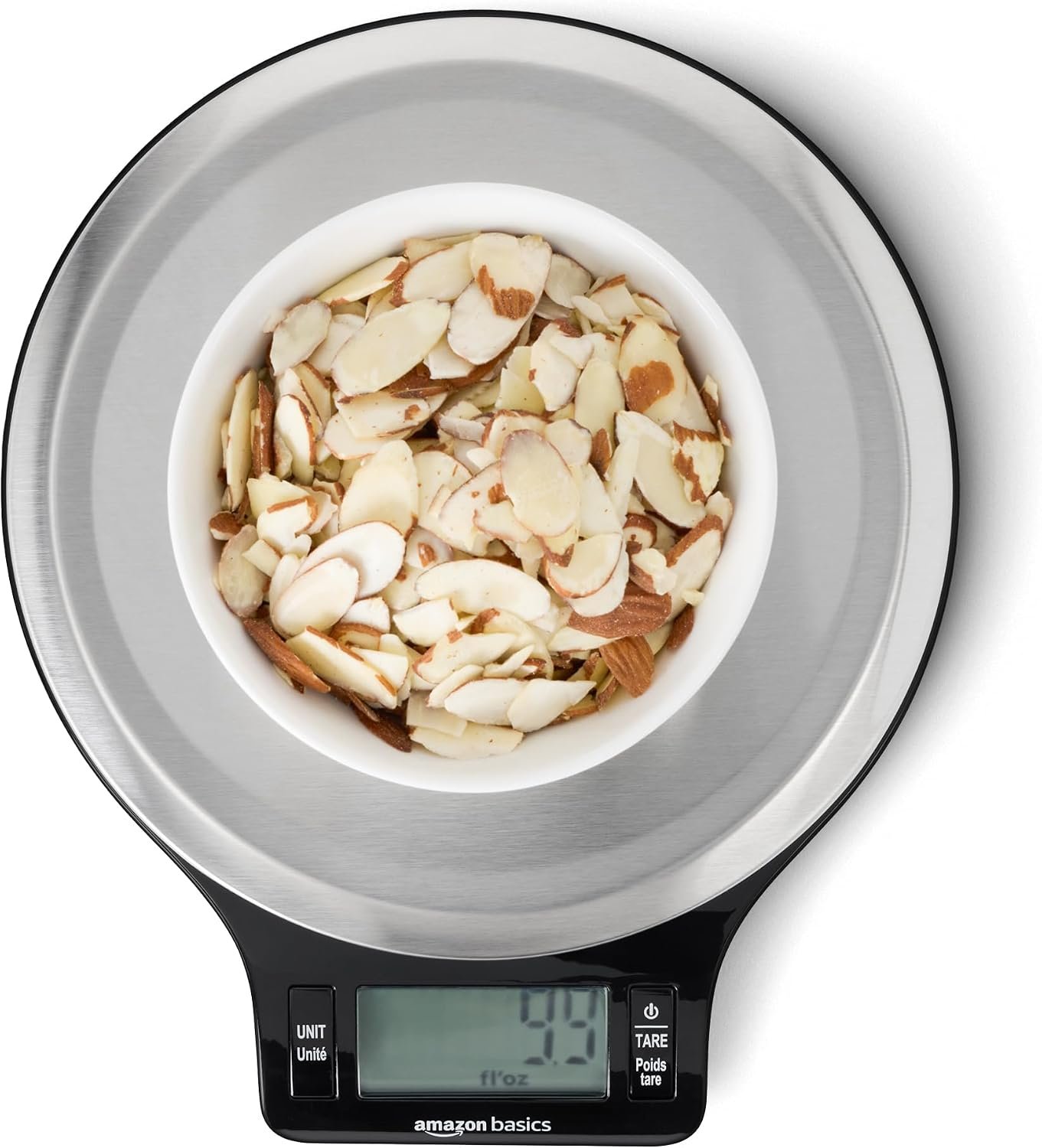
The Amazon Basics Digital Kitchen Scale with LCD Display is a compact food-measuring tool designed for everyday kitchen use. The model is described as having a digital LCD display, a tare function, multiple measurement units, a maximum capacity of 11 pounds, and batteries included. Its black and stainless-steel appearance is intended to fit naturally into a range of kitchen environments.
A digital kitchen scale can be useful for much more than following complicated recipes. It can help when portioning ingredients, dividing dough, weighing coffee beans, measuring food for meal preparation, checking quantities before freezing, or simply making recipes more consistent.
The important point is that a kitchen scale is a measuring tool, not a replacement for good cooking judgment. It provides a numerical weight, but the usefulness of that measurement depends on choosing the correct unit, placing the scale on a suitable surface, using the tare function correctly, and understanding the limitations of the device.
This guide explains how the Amazon Basics digital kitchen scale can fit into a normal cooking routine, how its features work in practical situations, who may find this type of scale useful, and what to consider before adding one to a kitchen.
Understanding Digital Kitchen Scales
A digital kitchen scale measures the weight of an ingredient or object and displays the result electronically.
Traditional measuring cups are based on volume. A digital scale measures weight.
That difference matters because ingredients can have very different densities.
For example, one cup of flour and one cup of brown sugar occupy approximately the same volume but do not have the same weight. Even within the same ingredient, the amount can vary depending on how tightly it is packed.
A scale therefore gives the cook another level of measurement control.
Instead of asking:
“How many cups of flour should I use?”
a recipe may specify:
“How many grams of flour should I use?”
The scale allows that quantity to be measured directly.
Key Features of the Amazon Basics Digital Kitchen Scale
The Amazon Basics model covered here is designed around several straightforward functions rather than complicated cooking technology.
Its main features include:
- Digital LCD display
- Tare function
- Multiple measurement units
- Maximum weighing capacity of 11 pounds
- Battery-powered operation
- Batteries included
- Black and stainless-steel construction
Each feature has a practical purpose.
Digital LCD Display
The LCD display is the part of the scale that communicates the measurement.
Digital displays are useful because they provide a direct numerical reading instead of requiring the user to interpret a mechanical dial.
Depending on the selected unit, the display can show the weight in the appropriate measurement format.
A clear display becomes particularly useful when weighing ingredients directly in a bowl or container.
For example, if you are preparing pancake batter, you can place the mixing bowl on the scale, tare it, and then add ingredients while watching the display.
This can reduce the need to use several measuring cups.
Why a Digital Display Is Useful
Imagine preparing a recipe that requires several ingredients.
With traditional volume measurements, you might need:
- Measuring cups
- Measuring spoons
- Liquid measuring containers
- Several bowls
With a kitchen scale, many dry ingredients can be measured directly into one container.
That can make the preparation process more streamlined.
It also makes it easier to stop adding an ingredient once the desired weight is reached.
The Tare Function
The tare function is one of the most useful features on a kitchen scale.
Tare allows the weight of an empty container to be reset so that the display returns to zero.
For example:
- Place a mixing bowl on the scale.
- Turn on or activate the scale as appropriate.
- Use the tare function.
- The display returns to zero.
- Add flour.
- Measure the required amount.
- Tare again.
- Add the next ingredient.
This means the scale measures the ingredients rather than requiring you to calculate the weight of the bowl.
Measuring Multiple Ingredients in One Bowl
The tare function becomes especially useful when making recipes with several dry ingredients.
Suppose a recipe calls for flour, sugar, oats, and nuts.
Instead of using a separate container for each ingredient, you can potentially place one mixing bowl on the scale.
You can then:
Tare → add flour → tare → add sugar → tare → add oats → tare → add nuts.
The result is a single bowl containing all the measured ingredients.
This can reduce the amount of kitchen equipment involved in preparation.
It may also reduce cleanup.
Tare Is Useful Beyond Baking
Tare is not limited to cake or bread recipes.
It can be useful for:
- Rice
- Pasta
- Coffee
- Vegetables
- Meat
- Spices
- Nuts
- Seeds
- Cereal
- Homemade granola
- Smoothie ingredients
- Pet-food portions
Any time the ingredient needs to be measured inside a container, tare can simplify the process.
Multiple Measurement Units
The scale supports multiple measurement units, which makes it more adaptable to recipes using different measurement systems.
This can be particularly useful when cooking from recipes originating in different countries.
One recipe may use ounces.
Another may use pounds.
A baking recipe may use grams.
Having multiple units available means the cook does not necessarily need to perform a separate conversion for every ingredient.
Why Measurement Units Matter
Consider a recipe that calls for 500 grams of flour.
If the scale is displaying ounces, you either need to convert the amount or change the scale to grams.
Selecting the correct unit before starting can prevent mistakes.
The same principle applies when measuring liquids or ingredients sold by weight.
The unit displayed on the scale should always match the unit specified by the recipe.
Maximum Capacity of 11 Pounds
The scale is designed to weigh items up to 11 pounds.
This gives it enough capacity for many everyday kitchen tasks.
For example, you can weigh:
- Ingredients
- Dough
- Large mixing bowls containing ingredients
- Produce
- Portions of meat
- Bags of dry goods
- Meal-prep portions
However, the maximum capacity includes the weight of the container placed on the scale.
This is an important detail.
If a heavy bowl is already sitting on the platform, part of the scale’s available capacity has already been used.
Understanding the 11-Pound Limit
A scale rated for 11 pounds should not be treated as though it can safely measure significantly heavier objects.
Exceeding the maximum capacity can affect measurement accuracy and may damage the scale.
For normal kitchen use, the stated capacity is suitable for many recipes.
For unusually large quantities, commercial food preparation, or very heavy containers, a larger-capacity scale may be more appropriate.
Using the Scale for Baking
Baking is one of the clearest examples of where a kitchen scale can be useful.
Baking recipes depend heavily on proportions.
Small differences in ingredients can affect:
- Texture
- Moisture
- Structure
- Density
- Rising
- Browning
Flour is a particularly good example.
Scooping flour directly from a container can produce different quantities depending on how tightly the flour is packed.
Weighing it provides a more direct measurement.
Bread Dough
Bread recipes frequently use weight-based measurements.
A recipe might specify:
- Flour
- Water
- Yeast
- Salt
- Sugar
- Oil
Instead of measuring each ingredient with cups and spoons, the scale can be used to measure ingredients by weight.
This can make repeated batches more consistent.
For people who bake bread regularly, that consistency can be useful when adjusting recipes.
Pizza Dough
Pizza dough is another practical application.
Suppose you are preparing several pizzas from one batch.
After mixing the dough, you can weigh the entire dough mass and divide it into equal portions.
For example, if the finished dough weighs 1,200 grams and you want four equal dough balls:
1,200 ÷ 4 = 300 grams per portion.
The scale makes it easier to create portions of approximately equal weight.
That can help produce pizzas with more consistent sizes.
Cookies
Cookie dough can also be portioned by weight.
Instead of estimating how much dough goes into each cookie, you can weigh individual portions.
This is useful when you want cookies that are approximately the same size.
Uniform portions can also help cookies bake more consistently because similarly sized pieces are more likely to finish around the same time.
Measuring Ingredients for Cooking
The usefulness of a kitchen scale extends beyond baking.
Many savory recipes can benefit from accurate ingredient quantities.
For example:
- Rice
- Pasta
- Meat
- Cheese
- Vegetables
- Nuts
- Grains
- Breadcrumbs
A scale can help divide ingredients according to a recipe or meal plan.
Portioning Meat
A kitchen scale can be useful when recipes call for specific amounts of meat.
For example, a recipe might call for 1 pound of ground beef.
Instead of estimating the amount visually, you can weigh it.
The same approach can be used when dividing a larger package into smaller portions before freezing.
Meal Preparation
Meal preparation is another situation where a kitchen scale can be practical.
Suppose you are preparing several containers for the week.
You may want each container to contain approximately the same amount of:
- Rice
- Chicken
- Vegetables
- Pasta
- Beans
Using the scale allows you to portion the ingredients according to weight.
This is particularly useful when consistency matters.
Dividing a Large Batch
Imagine making a large batch of cooked rice.
Rather than placing a random amount into each storage container, you can weigh the rice as you divide it.
For example, if you want five approximately equal portions, you can divide the total cooked amount into five similar weights.
The same principle works with:
- Chili
- Soup
- Stew
- Pasta
- Cooked grains
- Casseroles
Weighing Coffee
Coffee enthusiasts can also use kitchen scales.
Coffee preparation often involves a relationship between coffee grounds and water.
A scale can help measure the amount of coffee used rather than relying on a spoon.
For example, you might consistently measure a particular quantity of coffee beans before grinding.
The advantage is repeatability.
If a cup tastes good at a certain coffee-to-water ratio, weighing the ingredients makes it easier to reproduce the same starting point.
Measuring Homemade Granola
Granola recipes often contain several ingredients:
- Oats
- Nuts
- Seeds
- Dried fruit
- Coconut
- Sweeteners
- Spices
A scale can make it easier to measure the ingredients by weight.
It can also help divide the finished granola into portions for storage.
Cooking Rice and Grains
Rice is commonly measured by volume, but weighing it can provide another way to maintain consistency.
Different types of rice have different densities and preparation requirements.
A scale does not determine the correct cooking ratio by itself.
Instead, it helps you measure the quantity specified by your recipe.
The cooking instructions should still be followed for the particular grain.
Weighing Produce
The scale can also be useful for fruits and vegetables.
Some recipes call for:
- 8 ounces of mushrooms
- 1 pound of potatoes
- 500 grams of tomatoes
- A specific weight of chopped vegetables
Rather than estimating, the scale provides a direct measurement.
This can be particularly useful when adapting recipes.
Recipe Scaling
One of the more advanced uses for a kitchen scale is scaling recipes.
Suppose a recipe produces four servings but you want eight.
The ingredient quantities generally need to be adjusted accordingly.
Weight-based measurements make those calculations straightforward.
If a recipe requires 250 grams of flour for four servings, doubling the recipe means:
250 × 2 = 500 grams.
A scale then allows you to measure the adjusted quantity directly.
Reducing Measuring-Cup Cleanup
One underrated benefit of a tare-capable kitchen scale is that it can reduce the number of utensils needed.
Without a scale, a recipe may require:
- One cup for flour
- One cup for sugar
- Half a cup for another ingredient
- Several spoons
With a scale and a suitable bowl, multiple dry ingredients can be added sequentially.
That means fewer measuring utensils to wash afterward.
Using a Kitchen Scale for Freezer Preparation
A scale can also be helpful before freezing food.
For example, a large package of ground meat can be divided into smaller portions.
You might want several packages of similar weight.
Place the container or freezer-safe bag on the scale, tare it, and add the desired amount.
Label each package with the weight and date before freezing.
Homemade Meal Portions
If you prepare meals in advance, the scale can help create consistent portions.
This does not mean every meal has to be weighed.
Rather, it gives you a practical tool when exact portion sizes matter.
For example, if you are preparing five identical lunch containers, weighing the main components can make the portions more uniform.
Who May Find This Kitchen Scale Useful?
Home Bakers
People who regularly bake bread, cakes, cookies, pastries, or pizza dough can benefit from weight-based ingredient measurements.
Baking often involves ratios, making consistent measurement particularly useful.
Bread Bakers
Bread dough is especially suitable for weighing.
Flour, water, salt, and yeast can all be measured by weight.
Once a recipe is established, using the same weights each time makes it easier to reproduce the dough.
Coffee Enthusiasts
People who prepare pour-over or other measured coffee methods may appreciate a kitchen scale for weighing coffee grounds and other ingredients.
Meal Preppers
Anyone who prepares several meals in advance can use the scale to divide food into consistent portions.
Everyday Home Cooks
A kitchen scale does not have to be reserved for specialized cooking.
It can be useful for ordinary recipes when ingredients are given by weight.
It can also help when dividing large quantities of food.
People Following International Recipes
Recipes from different regions may use different measurement systems.
A scale with multiple units can make it easier to work with recipes that use grams, ounces, or pounds.
People With Limited Kitchen Space
A compact digital scale can serve several purposes without requiring a large appliance.
It can be stored when not needed and brought out during meal preparation.
Important Things to Consider
A Kitchen Scale Is a Measuring Instrument
A digital scale is useful, but it should be treated as a measuring instrument rather than an automatic guarantee of perfect results.
The accuracy of a measurement depends partly on how the scale is used.
Place It on a Stable Surface
The scale should be placed on a flat, stable surface.
Avoid using it on:
- Soft towels
- Uneven countertops
- Wet surfaces
- Surfaces that move while measuring
A stable base helps produce more consistent readings.
Keep the Scale Dry
Kitchen environments involve water, sauces, steam, and other liquids.
The scale should be protected from unnecessary exposure to moisture.
If an ingredient spills onto the scale, clean it according to the manufacturer’s instructions.
Do not assume that an electronic kitchen scale is waterproof.
Avoid Overloading
The maximum stated capacity is 11 pounds.
Do not place objects exceeding that capacity on the platform.
If the container is heavy, remember that its weight counts toward the total.
Choose the Correct Unit
Before measuring, check the display.
If the recipe calls for grams but the scale is displaying ounces, the number will not match directly.
Make the unit selection before adding ingredients.
Use the Tare Function Carefully
Tare is simple, but it should be used deliberately.
If you tare the scale after adding an ingredient, the display returns to zero.
That means the next number represents only the additional ingredient.
This is helpful when intentionally building a recipe ingredient by ingredient.
However, if you accidentally tare at the wrong time, you may lose track of the total weight.
Give the Display Time to Stabilize
When adding ingredients, add them gradually.
Wait for the measurement to settle before deciding whether more is required.
Pouring quickly can cause the display to change as the ingredient lands on the platform.
Avoid Placing Hot Cookware Directly on the Scale
A kitchen scale is intended for measuring food and ingredients, not necessarily for handling extremely hot cookware.
If you need to weigh cooked food, use an appropriate container and avoid exposing the scale to excessive heat.
Battery-Powered Convenience
The Amazon Basics model is battery operated, and the listed product description indicates that batteries are included.
This means it does not require a power cable during ordinary use.
That can make countertop placement more flexible.
You can use it in different parts of the kitchen without needing to keep it beside an outlet.
Battery Maintenance
Like other battery-powered kitchen devices, the scale depends on its batteries.
If the display becomes faint or the scale stops operating, the batteries may need replacement.
Keeping replacement batteries available can prevent interruptions during cooking.
If the scale will not be used for a long period, follow the manufacturer’s recommendations regarding battery storage and removal.
Cleaning the Scale
Food can easily come into contact with the weighing surface.
Ingredients such as flour and sugar can leave residue.
Wet ingredients can create larger spills.
Cleaning should be done according to the manufacturer’s care instructions.
A practical approach is to prevent liquids from reaching the electronic components.
Using a Bowl or Container
You do not have to place food directly onto the weighing platform.
In fact, using a bowl or container is often more practical.
The process is simple:
- Place the empty container on the scale.
- Use tare.
- Add the ingredient.
- Read the weight.
- Tare again if another ingredient is being added.
This method keeps the food contained and makes cleanup easier.
Measuring Liquid Ingredients
A kitchen scale can sometimes be useful for liquid ingredients when a recipe specifies weight.
However, weight and volume are not interchangeable for every liquid.
Water is often close to a simple relationship between milliliters and grams, but other liquids have different densities.
For ingredients such as oil, honey, or syrups, follow the recipe’s specified measurement method.
If the recipe gives a weight, use weight.
If it gives volume, use the appropriate volume measurement unless you have a reliable conversion.
Why Weight Can Be More Consistent Than Volume
Consider flour.
Two people can fill a measuring cup differently.
One may scoop directly from the bag.
Another may spoon flour into the cup and level it.
The resulting weights can differ.
A scale reduces that particular variation because the target is a specific numerical weight.
That does not make every recipe automatically better, but it provides a more repeatable way to measure ingredients.
Comparison of General Kitchen Scale Categories
Not every kitchen scale is designed for the same type of work.
Understanding the categories can help clarify where a basic digital kitchen scale fits.
| Kitchen Scale Category | Typical Use | Main Strength |
|---|---|---|
| Basic digital kitchen scale | Everyday cooking and baking | Simple ingredient measurement |
| Precision baking scale | Baking and recipe ratios | Fine measurements |
| Coffee scale | Coffee brewing | Coffee and water measurement |
| Large-capacity food scale | Large batches | Higher weight capacity |
| Mechanical kitchen scale | Traditional cooking | No electronic power required |
| Portion-control scale | Dividing food | Consistent serving weights |
The Amazon Basics model belongs primarily to the basic digital kitchen scale category.
Its 11-pound capacity makes it appropriate for many ordinary household food-measuring tasks.
Digital Scale vs. Mechanical Scale
Mechanical kitchen scales use a spring or similar mechanism and usually display the measurement on a dial.
Digital scales provide the measurement electronically.
A digital model is often easier to read at a glance because the result appears as a number.
Mechanical models, on the other hand, do not require batteries.
The choice depends on the user’s priorities.
Basic Digital Scale vs. Precision Scale
A standard kitchen scale is designed for common food measurements.
A precision scale is intended for situations where very small increments are important.
For ordinary flour, sugar, rice, meat, and meal-prep portions, a basic kitchen scale may provide sufficient functionality.
For highly specialized applications requiring extremely fine measurements, a dedicated precision scale may be more appropriate.
Basic Kitchen Scale vs. Coffee Scale
Coffee scales often include features specifically designed for brewing, such as timing functions and specialized water measurement displays.
A general kitchen scale may not include those coffee-specific features.
However, it can still be useful for weighing coffee beans or grounds.
The distinction is mainly about specialization.
Practical Ways to Get More From the Scale
Weigh Before Cooking
If you are preparing a recipe from scratch, organize the ingredients before beginning.
Place the bowl on the scale and measure each ingredient carefully.
This can reduce interruptions once cooking starts.
Prepare Ingredients in Advance
For complicated recipes, weigh ingredients before heating the stove or oven.
For example:
Flour: measured
Sugar: measured
Spices: measured
Nuts: measured
Then cooking becomes more about combining ingredients rather than stopping repeatedly to measure.
Use It for Dough Division
After making dough, weigh the entire batch.
Divide the total weight by the number of portions you need.
This gives you a target weight for each piece.
It works especially well for:
- Pizza dough
- Bread rolls
- Burger buns
- Dinner rolls
- Tortillas
- Cookies
Use It When Adapting Recipes
A scale is especially useful when changing recipe quantities.
If you increase a recipe by 50%, simply multiply the weight of each ingredient by 1.5.
For example:
200 g flour × 1.5 = 300 g
This approach is generally easier than converting fractional measuring cups.
Use It for Homemade Spice Blends
A scale can be used to make repeatable spice blends.
For example, you might create a blend using:
- Paprika
- Cumin
- Garlic powder
- Black pepper
- Chili powder
Weighing the ingredients allows you to reproduce the blend later.
This can be useful when preparing larger batches.
Use It for Homemade Granola
Granola benefits from measured proportions.
If you create a recipe you enjoy, record the weights.
The next batch can then be prepared using the same measurements.
That turns an improvised recipe into something more repeatable.
Use It for Food Storage
Before putting food into containers, you can weigh portions.
This is useful when you want several containers containing similar amounts.
Labeling the containers with dates and contents can make storage easier to manage.
Frequently Asked Questions
What is the Amazon Basics Digital Kitchen Scale?
It is an electronic kitchen scale designed to measure food and other kitchen ingredients by weight. The listed model includes an LCD display, tare function, multiple units, and an 11-pound maximum capacity.
What is the maximum weight it can measure?
The scale is listed with a maximum capacity of 11 pounds.
The container and food together should remain within the stated capacity.
Does it have a tare function?
Yes.
The tare function allows the weight of a bowl or other container to be reset so that only the ingredients added afterward are measured.
Why is the tare function useful?
It allows you to measure ingredients directly inside a bowl.
You can also add multiple ingredients sequentially by using tare between measurements.
Can I use it for baking?
Yes.
A digital kitchen scale can be particularly useful for flour, sugar, butter, dough, nuts, and other baking ingredients.
Can I weigh dough?
Yes.
The scale can be used to measure dough portions, provided the total weight remains within its capacity.
Can I divide pizza dough with it?
Yes.
You can weigh the finished dough and divide it into portions of approximately equal weight.
Can I use it for bread baking?
Yes.
Weight-based measurements are commonly used in bread recipes.
A scale can help measure flour, water, salt, yeast, and other ingredients according to the recipe.
Can I weigh meat?
Yes.
Suitable quantities of meat can be weighed on the scale, provided the total weight is within the stated capacity.
Use a clean, suitable container when necessary.
Can I use it for meal preparation?
Yes.
It can help divide rice, meat, vegetables, pasta, and other foods into consistent portions.
Can I use it to weigh coffee?
Yes.
Coffee beans or grounds can be weighed with a kitchen scale.
However, dedicated coffee scales may include additional brewing-oriented features.
Can it measure grams?
The product is described as supporting multiple measurement units.
Select the appropriate unit according to the recipe and the scale’s available settings.
Can it measure ounces?
The product is described as supporting multiple units, making it suitable for recipes that use different measurement systems.
Check the available unit options on the specific scale before use.
Can it measure pounds?
The scale’s 11-pound maximum capacity makes pounds an appropriate unit for larger kitchen quantities within its capacity.
Are batteries included?
The listed product description states that batteries are included.
Does it need to remain plugged in?
No.
The scale is battery powered, allowing it to operate without a continuous electrical connection.
Can I place a bowl on the scale?
Yes.
Using a bowl is one of the most practical ways to use a kitchen scale.
Place the bowl on the platform and use tare before adding ingredients.
Can I measure several ingredients in one bowl?
Yes.
After measuring one ingredient, use the tare function to return the display to zero before adding the next ingredient.
Can I use it for liquids?
It can be used when the recipe calls for a liquid ingredient by weight and the container is suitable.
For liquids measured by volume, use the measurement method specified by the recipe.
Is a kitchen scale more accurate than measuring cups?
A scale can provide more consistent weight-based measurements, particularly for ingredients such as flour where volume measurements can vary depending on how the ingredient is packed.
However, accuracy also depends on using the scale correctly.
Can I use the scale for recipe conversions?
It can help with recipe conversions because weight-based quantities are easy to multiply or divide.
For example, doubling 250 grams produces 500 grams.
Can I use it to portion frozen food?
It can be useful for dividing food into portions before freezing.
Use suitable containers or bags and keep the total weight within the scale’s capacity.
Can I weigh a large mixing bowl?
You can weigh a bowl provided that the combined weight of the bowl and its contents does not exceed the scale’s maximum capacity.
What happens if I exceed 11 pounds?
Exceeding the stated maximum capacity is not recommended.
It may produce unreliable readings or potentially damage the scale.
Where should I place the scale?
Use a stable, level, dry surface.
A solid countertop is generally more suitable than an unstable or soft surface.
Can I put a hot pan on it?
A kitchen scale is primarily intended for weighing ingredients.
Avoid placing extremely hot cookware directly on the weighing platform unless the manufacturer’s instructions specifically indicate that it is appropriate.
How should I clean it?
Clean it according to the manufacturer’s instructions.
Prevent excessive moisture from reaching the electronic components.
Is this type of scale suitable for professional kitchens?
The 11-pound capacity can cover many everyday food-measuring tasks, but professional kitchens may require equipment designed for heavier workloads, higher capacities, or specialized sanitation requirements.
Conclusion
The Amazon Basics Digital Kitchen Scale with LCD Display, Tare Function, Multiple Units, and an 11-Pound Capacity is designed around a simple idea: making food measurements more direct and repeatable.
Its usefulness does not depend on complicated technology.
The LCD display provides an easy-to-read numerical measurement, while the tare function makes it possible to weigh ingredients inside a bowl without manually subtracting the container’s weight.
Multiple measurement units provide flexibility when working with recipes that use different systems, while the 11-pound capacity gives the scale enough range for many common household cooking tasks.
For bakers, the scale can help measure flour, sugar, butter, dough, nuts, and other ingredients by weight. Bread and pizza makers can use it to divide dough into similar portions. Home cooks can use it for meat, vegetables, grains, rice, and recipe ingredients. Coffee drinkers can use it to weigh beans or grounds. People preparing meals in advance can use it to divide food into consistent portions.
The tare function may be particularly valuable in everyday use. Rather than repeatedly reaching for different measuring cups, you can place one bowl on the scale, reset it, add an ingredient, reset it again, and continue through the recipe.
That approach can make preparation more organized and may reduce the number of utensils used.
There are also some practical limitations to remember.
The scale has an 11-pound maximum capacity, so unusually heavy containers or large quantities may require a higher-capacity model. The surface should be kept stable and dry, and the electronic components should be protected from unnecessary exposure to water. The correct measurement unit should always be selected before weighing, and ingredients should be added gradually enough for the displayed measurement to stabilize.
A kitchen scale also does not replace the recipe itself. It tells you the weight of what you place on it; it does not determine how much of an ingredient a particular recipe requires. For the most reliable results, use the measurements specified by the recipe and select the corresponding unit.
Ultimately, the value of a digital kitchen scale comes from consistency. When you know the weight of an ingredient, dough portion, or prepared-food serving, it becomes easier to reproduce the same quantity the next time.
For a household that bakes regularly, prepares meals in batches, works with recipes using grams or ounces, or simply wants a straightforward way to measure kitchen ingredients, a compact digital scale can be a useful addition to the countertop.