Introduction
A frying pan is one of the most frequently used pieces of cookware in a kitchen. It can handle everything from a quick breakfast to sautéed vegetables, seared meat, reheated leftovers, sauces, and one-pan dinners. Because different foods require different amounts of cooking space, having more than one pan size can also make everyday preparation easier.
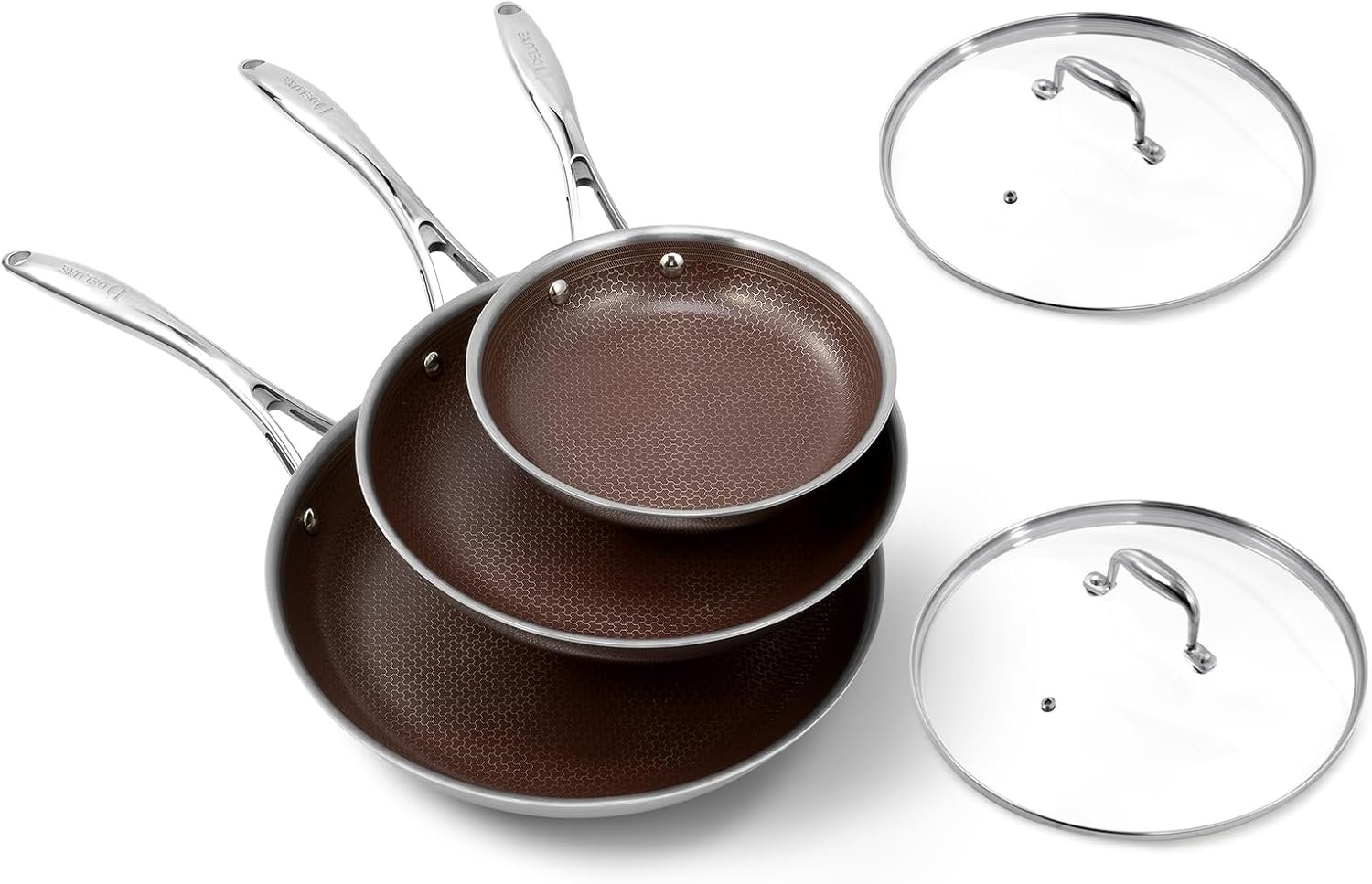
The Deluxe 5pc Hybrid Nonstick Frying Pans Set with Lids is designed around that idea, offering three frying pan sizes—8, 10, and 12 inches—along with lids. The set provides several cooking surfaces in different dimensions, allowing the cook to select a pan according to the quantity of food being prepared.
A smaller pan can be useful for an individual serving or a few eggs. A medium-sized pan can handle everyday sautéing, vegetables, or smaller portions of meat. A 12-inch pan provides additional cooking surface for larger meals or ingredients that need to be spread out rather than crowded together.
The term hybrid nonstick is also worth understanding. Hybrid cookware generally combines characteristics associated with traditional nonstick cookware and textured or structured cooking surfaces. The exact construction, coating materials, compatibility with cooktops, oven limitations, and care instructions can vary considerably between products, so the manufacturer’s instructions should always be used as the final reference for this particular set.
This article looks at the Deluxe 5pc Hybrid Nonstick Frying Pans Set from an informational perspective. Rather than presenting it as a product to rate, the goal is to explain the purpose of the different pan sizes, how a frying-pan set can be used in everyday cooking, what the hybrid nonstick concept means, who may find a multi-size set useful, and what should be considered before choosing cookware for a kitchen.
Understanding the 5-Piece Frying Pan Set
The set is built around three frying pans:
- 8-inch frying pan
- 10-inch frying pan
- 12-inch frying pan
The set also includes lids.
Having multiple sizes is useful because pan size affects cooking surface, ingredient capacity, heat distribution, and how much space food has while cooking.
A common mistake in home cooking is choosing a pan that is too small for the quantity being prepared.
When a pan becomes crowded, food can release moisture faster than it can evaporate. Instead of developing the desired browning, ingredients may begin to steam.
A larger pan is not always better, though.
Using an oversized pan for a single egg or a small amount of food can make handling less convenient and may spread the ingredients too thinly across the cooking surface.
That is where a multi-size set becomes practical.
The 8-Inch Frying Pan
The smallest pan in the set is the 8-inch frying pan.
This size can be particularly convenient for small portions.
Possible uses include:
- One or two eggs
- Omelets
- Small pancakes
- Toasting nuts
- Warming small portions
- Sautéing a small amount of vegetables
- Preparing a single-serving meal
- Cooking small pieces of meat
An 8-inch pan can be easier to handle than a large skillet when the quantity of food is limited.
Cooking Eggs in an 8-Inch Pan
Eggs are one of the simplest applications for a small frying pan.
You can use it for:
- Fried eggs
- Scrambled eggs
- Small omelets
- Egg sandwiches
- Breakfast portions
The smaller cooking surface can keep the ingredients relatively concentrated.
For an omelet, for example, the size can help produce a compact shape that is easier to fold.
Small Pancakes
The 8-inch pan can also be used for smaller pancakes.
If you are preparing several pancakes, a larger pan may allow you to cook more at once.
But for a single portion, a smaller pan can be easier to manage.
Toasting Nuts and Seeds
Dry ingredients such as nuts and seeds can be lightly toasted in a frying pan.
Examples include:
- Almonds
- Walnuts
- Pecans
- Pumpkin seeds
- Sunflower seeds
Use moderate heat and stir frequently.
Nuts can transition from lightly toasted to burnt relatively quickly.
The 10-Inch Frying Pan
The 10-inch pan sits between the smaller and larger options.
This is a versatile size for many everyday meals.
Potential uses include:
- Sautéed vegetables
- Chicken pieces
- Burgers
- Fish fillets
- Stir-fried ingredients
- Omelets
- Pancakes
- Grilled sandwiches
- Small pasta sauces
It offers more cooking surface than the 8-inch pan without occupying as much space as the 12-inch model.
Everyday Breakfast Cooking
A 10-inch skillet can be useful for a larger breakfast.
For example, you might prepare:
- Eggs
- Hash browns
- Sausage
- Mushrooms
- Peppers
Using separate pans can make preparation easier when different foods require different cooking times.
Alternatively, some dishes can be prepared in stages in one pan.
Sautéing Vegetables
Sautéing works particularly well in a medium frying pan.
Common vegetables include:
- Onions
- Bell peppers
- Mushrooms
- Zucchini
- Spinach
- Broccoli
- Asparagus
Cut the vegetables into relatively similar sizes so that they cook at approximately the same rate.
Cooking Fish Fillets
Fish is another useful application for a medium skillet.
The pan should be large enough for the fillets to sit without excessive crowding.
If the fillets are too close together, moisture may build up and interfere with browning.
The 10-inch size can be appropriate for smaller portions, while the 12-inch pan may be more practical for several larger fillets.
The 12-Inch Frying Pan
The largest pan in the set is 12 inches.
A 12-inch frying pan provides substantially more cooking surface.
It can be useful for:
- Family-size meals
- Several chicken breasts
- Multiple burgers
- Stir-fried vegetables
- Large omelets
- Sautéed potatoes
- One-pan meals
- Larger quantities of pasta sauce
- Seared meats
The larger surface can be particularly valuable when ingredients need space.
Why Cooking Surface Matters
Pan diameter is not simply about capacity.
It also influences how food cooks.
Consider diced vegetables.
If you put a large quantity into a small pan, the pieces may overlap.
The moisture released from the vegetables has less room to evaporate.
The result can be softer food with less browning.
A larger skillet spreads the ingredients over a wider surface.
This can provide better contact between the food and the heated cooking surface.
Cooking Multiple Burgers
The 12-inch pan can be useful when preparing several burgers.
Place the patties with enough room between them.
Avoid pressing them together.
The available surface can make it easier to flip individual patties without disturbing neighboring food.
Always cook ground meat to a safe internal temperature.
One-Pan Chicken Dinner
A 12-inch skillet can also be used for a simple one-pan chicken meal.
A general sequence might be:
- Season the chicken.
- Preheat the pan appropriately.
- Brown the chicken.
- Remove it temporarily if necessary.
- Sauté onions and vegetables.
- Add the chicken back.
- Add an appropriate sauce or cooking liquid.
- Finish cooking according to the recipe.
The exact process depends on the dish.
Understanding Hybrid Nonstick Cookware
The word hybrid can refer to cookware that combines a textured or patterned cooking surface with a nonstick-oriented design.
The purpose is generally to balance food release with the cooking characteristics associated with a structured surface.
However, “hybrid nonstick” is not a universal technical standard.
Different manufacturers can use different construction methods.
For this reason, it is important to consult the specific manufacturer’s documentation regarding:
- Coating composition
- Utensil compatibility
- Oven use
- Dishwasher use
- Maximum temperature
- Cleaning requirements
- Cooktop compatibility
What Nonstick Cookware Is Designed to Do
Nonstick cookware is primarily intended to reduce the tendency of food to adhere to the cooking surface.
That can be particularly useful for:
- Eggs
- Pancakes
- Fish
- Delicate vegetables
- Low-fat cooking
- Sticky sauces
However, nonstick does not mean food can never stick.
Temperature, cooking time, food moisture, oil quantity, and surface condition all affect food release.
Why Eggs Benefit From Nonstick Cookware
Egg proteins can adhere strongly to metal surfaces under certain cooking conditions.
A suitable nonstick cooking surface can make eggs easier to release.
For scrambled eggs, omelets, or fried eggs, this can simplify both cooking and cleanup.
Use appropriate heat.
Excessive heat is unnecessary for most egg preparations.
Pancakes and Nonstick Surfaces
Pancake batter contains ingredients that can adhere to a pan if the surface is unsuitable or overheated.
A nonstick-oriented skillet can make flipping easier.
Use moderate heat and allow the pancake to set before turning it.
Fish and Food Release
Fish can be delicate.
A fillet may break if it sticks when you try to turn it.
A suitable nonstick surface can help reduce that problem.
The pan should still be properly preheated, and the fish should be allowed to develop enough structure before flipping.
Using Oil With Nonstick Cookware
Nonstick cookware generally does not require the same quantity of oil as traditional uncoated metal cookware.
However, a small amount of suitable cooking oil can still be useful for:
- Browning
- Flavor
- Heat transfer
- Preventing certain foods from sticking
The appropriate amount depends on the recipe.
Avoiding Excessive Heat
Nonstick cookware should generally be used within the manufacturer’s temperature recommendations.
High heat is not automatically better.
For many foods, moderate heat provides better control.
This is particularly true for:
- Eggs
- Fish
- Pancakes
- Garlic
- Delicate sauces
High heat can cause food to burn before the interior is properly cooked.
How the Lids Add Flexibility
The set includes lids, which can expand the ways the frying pans are used.
A lid can help:
- Retain heat
- Trap steam
- Reduce splattering
- Finish cooking food
- Keep prepared food covered temporarily
- Simmer suitable dishes
The appropriate lid should be matched to the corresponding pan according to the manufacturer’s design.
Using a Lid for Vegetables
Some vegetables benefit from a short covered cooking period.
For example, you might sauté vegetables first and then cover the pan briefly to soften them.
This allows steam to remain inside the cooking environment.
Using a Lid for Chicken
A lid can help retain heat while thicker pieces of chicken finish cooking.
However, covering the pan can also reduce evaporation.
If the recipe requires browning or sauce reduction, you may want the pan uncovered during those stages.
Simmering With a Lid
A covered pan can help maintain a steady cooking environment for sauces and other suitable dishes.
If a sauce needs to thicken through evaporation, leave the lid off or partially cover the pan depending on the recipe.
Preventing Splashes
A lid can also be useful when cooking foods that splatter.
Examples include:
- Tomato sauces
- Ground meat
- Bacon
- Certain sautéed vegetables
The lid can help contain some of the mess.
Three Sizes for Different Cooking Situations
One of the strongest practical reasons to use a multi-pan set is that the cook does not need to force every recipe into one skillet.
Consider a typical day.
Breakfast
Use the 8-inch pan for eggs.
Lunch
Use the 10-inch pan for sautéed vegetables and chicken.
Dinner
Use the 12-inch pan for a family-size stir-fry.
Each pan serves a different role.
Using Two Pans at Once
Having multiple pans can also make multi-component meals easier.
For example:
10-inch pan: Sauté mushrooms and onions.
12-inch pan: Cook chicken or steak.
This can reduce the need to cook everything sequentially.
Preparing Family Meals
The 12-inch skillet can provide additional room for family portions.
Potential meals include:
- Chicken and vegetables
- Beef and peppers
- Pasta sauce
- Stir-fry
- Breakfast hash
- Sautéed potatoes
- Skillet rice dishes
- Vegetable medleys
The amount of food that can comfortably fit depends on ingredient size and recipe.
Avoiding Overcrowding
Even a 12-inch pan can become overcrowded.
If food is piled too deeply, moisture can accumulate.
For better browning, work in batches when necessary.
It may seem slower initially, but allowing ingredients to cook properly can produce a better texture.
Cooking With Different Heat Levels
Different ingredients require different heat levels.
Low Heat
Useful for:
- Melting butter
- Warming food
- Gentle sauces
- Eggs
- Keeping food warm
Medium Heat
Useful for:
- Sautéing vegetables
- Pancakes
- Chicken
- Fish
- General skillet cooking
Higher Heat
May be useful for certain searing applications if the cookware manufacturer’s instructions permit it.
Always consider the cookware’s temperature limitations.
Preheating the Pan
Preheating can help create more consistent cooking.
However, do not leave an empty nonstick pan over high heat for an extended period.
Use an appropriate heat setting and add food when the pan reaches the desired cooking condition.
Cooking Meat
The different pan sizes can accommodate different amounts of meat.
The 8-inch pan may work for a small steak or individual portion.
The 10-inch pan can handle several smaller pieces.
The 12-inch pan provides more room for multiple servings.
Avoid crowding the meat.
Cooking Chicken Breast
Chicken breast benefits from controlled heat.
Start with appropriate seasoning.
Brown the outside.
Then continue cooking until the internal temperature reaches a safe level.
A thermometer is more reliable than judging doneness from exterior appearance alone.
Cooking Steak
For steak, surface contact matters.
A pan should be large enough to accommodate the steak without unnecessary crowding.
Allow the pan to heat appropriately according to the cookware instructions.
Then sear the steak according to the recipe and desired doneness.
Cooking Vegetables
The set can support several vegetable techniques:
- Sautéing
- Browning
- Stir-frying
- Softening
- Simmering
Different vegetables require different cooking times.
Hard vegetables such as carrots generally take longer than leafy greens.
Making Stir-Fry
A 12-inch pan can be useful for smaller home-style stir-fries.
Possible ingredients include:
- Chicken
- Beef
- Shrimp
- Bell peppers
- Broccoli
- Carrots
- Snow peas
- Mushrooms
Cook ingredients in stages when necessary.
Adding everything at once can overcrowd the pan.
Shrimp
Shrimp cook relatively quickly.
The 8- or 10-inch pan can be useful for smaller portions, while the 12-inch pan provides more space for larger batches.
Avoid overcooking.
Shrimp can become rubbery when cooked for too long.
Making Sauces
Frying pans are not only for frying.
They can also be used to prepare:
- Tomato sauce
- Cream sauces
- Mushroom sauce
- Pan sauces
- Garlic butter
- Gravy
A lid can be helpful when a sauce needs gentle cooking, but remember that covering the pan reduces evaporation.
Pan Sauces After Cooking Meat
After cooking chicken or another protein, a pan can be used to create a quick sauce.
For example:
- Remove the cooked meat.
- Add aromatics.
- Add suitable liquid.
- Scrape appropriate browned residue from the pan.
- Reduce the sauce.
- Return the meat if appropriate.
Use utensils compatible with the cookware surface.
Cooking With a Nonstick Surface
Nonstick cookware is often associated with lower-oil cooking.
That can be useful for foods that naturally release some fat.
For example, ground beef can release its own fat as it cooks.
Eggs may need only a small amount of butter or oil.
The amount of cooking fat should follow the recipe and personal preference.
Cleaning Hybrid Nonstick Cookware
Cleaning requirements depend on the exact construction of the pans.
The safest approach is to follow the manufacturer’s instructions.
For routine cleaning, avoid assuming that aggressive scrubbing is necessary.
Use appropriate cleaning tools.
Avoid steel wool or harsh abrasive materials unless explicitly approved.
Why Gentle Cleaning Matters
The cooking surface is one of the most important parts of a nonstick pan.
Repeatedly scratching or damaging it can affect food-release characteristics.
A gentle cleaning routine can help maintain the surface.
Dealing With Burnt Food
If food becomes stuck, avoid immediately scraping aggressively.
Instead, allow the pan to cool.
Then follow an appropriate soaking or cleaning method recommended for the cookware.
Using harsh tools may cause unnecessary surface damage.
Dishwasher Considerations
Some cookware is dishwasher safe, while other nonstick cookware is intended to be hand washed.
The presence of a lid does not automatically mean every component is dishwasher safe.
Check the manufacturer’s instructions for the Deluxe set before placing any piece into a dishwasher.
Storage
Three frying pans naturally require more storage than a single skillet.
Fortunately, different pan sizes can often be nested or arranged efficiently if the cookware design permits it.
Take care when stacking coated surfaces.
If necessary, use appropriate protective separators to prevent scratching.
Countertop and Cabinet Space
Before choosing a multi-piece cookware set, consider where it will be stored.
You may need space for:
- Three pans
- Multiple lids
- Handles
- Other cookware
A dedicated cabinet shelf can make organization easier.
Who May Find This Cookware Set Useful?
New Kitchens
Someone furnishing a kitchen for the first time may benefit from having several common frying-pan sizes available.
Instead of buying separate pans one at a time, a multi-size set provides a starting collection.
Families
Families often prepare different quantities of food throughout the day.
A small pan may be sufficient for breakfast.
A large skillet may be needed for dinner.
The three sizes allow the cook to select the appropriate surface.
Couples
A couple may frequently prepare meals that fall somewhere between individual and family-size portions.
The 10-inch skillet can be useful for everyday meals, while the 8-inch pan can handle smaller preparations.
Meal Preppers
People who prepare multiple components at once can benefit from having more than one pan.
One pan can cook vegetables while another handles protein.
Apartment Kitchens
A set of three frying pans can reduce the need to purchase multiple individual pieces.
However, apartment kitchens may have limited storage, so the available cabinet space should be considered.
People Replacing Old Cookware
If existing pans have worn surfaces, damaged handles, or inconsistent heating, a coordinated set can provide several replacement sizes.
Important Things to Consider Before Choosing
Verify Cooktop Compatibility
Do not assume that every frying pan works with every type of cooktop.
Check compatibility with:
- Gas
- Electric
- Glass-top electric
- Induction
Induction compatibility in particular depends on the cookware’s magnetic construction.
Use the manufacturer’s specifications as the final authority.
Oven Compatibility
Some frying pans can go into an oven.
Others cannot.
The same applies to lids.
Never assume oven compatibility simply because a pan has metal components.
Check the maximum temperature and whether the lid is oven safe before using it in an oven.
Handle Temperature
Cookware handles can become hot depending on the cooking method and stove configuration.
Use appropriate caution.
If the pan has been in the oven, assume that exposed components may be hot unless specifically designed otherwise.
Nonstick Care
If the set uses a hybrid nonstick cooking surface, use utensils appropriate for that surface.
Avoid unnecessarily aggressive scraping.
Avoid overheating.
Clean according to the manufacturer’s instructions.
Pan Size and Food Quantity
Choose the pan based on the amount of food.
A small portion in an 8-inch pan may be easier to manage.
A family meal may require the 12-inch pan.
Using the appropriate size can improve both convenience and cooking control.
Weight and Handling
Larger pans are generally more substantial than smaller pans.
A 12-inch skillet filled with food can become heavy.
Use both hands where appropriate when transferring a full pan, particularly when moving it from the stovetop.
Lids and Storage
Because the set includes lids, storage requirements extend beyond the pans themselves.
Consider where the lids will be placed so that they remain accessible without taking over an entire cabinet.
Comparison of General Frying Pan Categories
Different types of frying pans are designed around different priorities.
| Cookware Category | Typical Strength | Common Uses |
|---|---|---|
| Traditional nonstick pan | Food release and easy everyday cooking | Eggs, pancakes, delicate foods |
| Hybrid nonstick pan | Combination of textured surface and nonstick characteristics | Everyday sautéing, searing, general cooking |
| Stainless-steel skillet | Browning and high-heat cooking | Meat, vegetables, pan sauces |
| Cast-iron skillet | Heat retention | Searing, roasting, skillet meals |
| Carbon-steel pan | High-heat cooking and seasoning | Searing, stir-frying, general skillet cooking |
| Ceramic-coated pan | Nonstick-oriented cooking surface | Eggs, vegetables, low-oil cooking |
The appropriate category depends on cooking habits.
A hybrid nonstick set can be useful when the goal is to combine everyday food release with a more structured cooking surface.
Hybrid Nonstick vs. Traditional Nonstick
Traditional nonstick cookware typically focuses strongly on easy food release.
Hybrid designs may incorporate a textured or patterned surface intended to provide a different balance between nonstick performance and cooking surface characteristics.
The actual construction differs by manufacturer.
It is therefore better to evaluate the specifications of the individual cookware set rather than assuming that all hybrid cookware behaves identically.
Hybrid Nonstick vs. Stainless Steel
Stainless steel is valued for browning and versatility.
Food can stick to stainless steel, especially if the pan is not heated or used appropriately.
Hybrid nonstick cookware is generally designed to provide easier food release.
The trade-off is that the cooking surface may require more specific care.
Hybrid Nonstick vs. Cast Iron
Cast iron is known for heat retention and can handle high temperatures when properly maintained.
It is also heavy and requires seasoning or appropriate care depending on the cookware.
A multi-size hybrid set offers a different experience, particularly for everyday foods that benefit from easier release.
Hybrid Nonstick vs. Ceramic-Coated Cookware
Ceramic-coated cookware uses a ceramic-based nonstick surface.
Hybrid cookware may use a different construction or combination of surface features.
Both can be used for lower-oil cooking, but care instructions and temperature limits vary.
Everyday Cooking Ideas
Breakfast Hash
Use the 12-inch pan for:
- Potatoes
- Onions
- Peppers
- Sausage
- Eggs
Cook the potatoes until appropriately browned, add vegetables, then finish with eggs.
Chicken and Peppers
Use the 10- or 12-inch pan.
Brown sliced chicken.
Add onions and peppers.
Finish with seasonings and an appropriate sauce.
Serve with rice, tortillas, or another side.
Garlic Shrimp
The 8- or 10-inch pan can work for a smaller portion.
Heat suitable oil or butter.
Add garlic.
Add shrimp.
Cook until the shrimp reaches a safe doneness.
Finish with lemon and herbs.
Vegetable Stir-Fry
The 12-inch pan provides more surface area for vegetables.
Use a mixture such as:
- Broccoli
- Carrots
- Bell peppers
- Mushrooms
- Snow peas
Cook in batches if necessary.
Mushroom and Onion Sauté
The 10-inch pan can be used to sauté mushrooms and onions for:
- Steak
- Burgers
- Pasta
- Toast
- Omelets
Allow the mushrooms enough room to release moisture and brown.
Pancakes
The 8-inch or 10-inch pan can be used for pancakes.
Maintain moderate heat.
Wait until bubbles form and the surface begins to set before flipping.
Grilled Cheese
A 10-inch frying pan is a convenient size for grilled cheese sandwiches.
Cook over moderate heat so the bread browns without burning before the cheese melts.
Quesadillas
The 10- or 12-inch pan can accommodate tortillas.
Add cheese and suitable fillings.
Fold or cover with another tortilla.
Cook until the exterior is browned and the cheese melts.
Fried Rice
The 12-inch pan can be used for a smaller home-style fried rice.
Cook ingredients in stages.
Cold cooked rice generally works well because it is less likely to become overly soft during stir-frying.
Shakshuka-Style Eggs
A frying pan with a lid can be useful for dishes where eggs cook in a tomato-based sauce.
Prepare the sauce.
Create spaces for the eggs.
Add the eggs.
Cover and cook until the eggs reach the desired level of doneness.
Frequently Asked Questions
What is included in the Deluxe 5pc Hybrid Nonstick Frying Pans Set?
The set includes three frying pans in 8-inch, 10-inch, and 12-inch sizes, along with lids.
What is the smallest pan?
The smallest frying pan is 8 inches.
It is useful for smaller portions and foods such as eggs and small pancakes.
What is the largest pan?
The largest frying pan is 12 inches.
It provides additional cooking surface for larger quantities and family-style meals.
Why are three pan sizes useful?
Different quantities of food require different amounts of cooking surface.
A smaller pan can be convenient for individual servings, while a larger pan can reduce overcrowding when preparing larger meals.
What does hybrid nonstick mean?
Hybrid nonstick generally refers to cookware that combines nonstick-oriented properties with a structured, textured, or patterned cooking surface.
The exact construction varies by manufacturer.
Can I cook eggs in these pans?
Frying pans with a nonstick-oriented surface are commonly suitable for eggs.
Use appropriate heat and utensils according to the manufacturer’s instructions.
Can I make pancakes?
Yes.
The smaller and medium-sized pans can be used for pancakes.
Can I cook chicken?
Yes.
Chicken can be sautéed or pan-cooked in an appropriately sized skillet.
Always cook poultry to a safe internal temperature.
Can I cook steak?
A frying pan can be used to sear steak, provided the cookware’s temperature recommendations permit the required heat.
Follow the manufacturer’s instructions for high-temperature cooking.
Can I cook vegetables?
Yes.
The pans can be used for sautéing, browning, and cooking suitable vegetables.
Can I cook stir-fry?
The 12-inch pan can be useful for smaller home-style stir-fries.
Avoid overcrowding the pan.
Can I use the pans for sauces?
Yes.
Frying pans can be used to prepare and reduce many sauces.
Are the lids useful for cooking?
Yes.
Lids can help retain heat, trap steam, reduce splattering, and finish suitable foods.
Can I put the pans in the oven?
Do not assume oven compatibility.
Check the manufacturer’s specifications for the exact pan and lid, including maximum temperature.
Are they dishwasher safe?
Dishwasher compatibility depends on the specific cookware instructions.
Check the manufacturer’s care guidance before placing the pans or lids in a dishwasher.
Can I use metal utensils?
Because the set is described as hybrid nonstick cookware, use utensils according to the manufacturer’s recommendations.
If the manufacturer does not explicitly approve metal utensils, non-abrasive utensils designed for coated cookware are the safer choice.
How should I clean the pans?
Follow the manufacturer’s cleaning instructions.
Avoid abrasive materials unless specifically approved.
Allow the cookware to cool before cleaning.
Can the pans be stacked?
The pans may be easier to store if arranged by size, but care should be taken to prevent surfaces from scratching each other.
Use protective separators if appropriate.
Which pan should I use for one egg?
The 8-inch pan is generally the most natural size for a small individual preparation such as one or two eggs.
Which pan should I use for family meals?
The 12-inch pan provides the most cooking surface in the set and is generally the more appropriate option for larger quantities.
Which pan is most versatile?
The 10-inch pan occupies the middle ground between individual portions and larger meals.
It can be useful for many everyday cooking tasks.
Can I use the pans for low-oil cooking?
Nonstick-oriented cookware can often be used with less oil than traditional uncoated cookware.
The amount needed depends on the food and recipe.
Why does food still stick to nonstick cookware?
Nonstick cookware does not guarantee zero sticking.
Possible causes include:
- Excessive heat
- Insufficient cooking fat for the particular recipe
- Food being moved too early
- A damaged cooking surface
- Incorrect cleaning products
- Sugary or sticky ingredients
How can I reduce sticking?
Use appropriate heat, allow the pan to preheat as recommended, use suitable cooking fat when necessary, and use utensils compatible with the surface.
Why does food not brown properly?
One common cause is overcrowding.
Too many ingredients release moisture into the pan.
Using the larger 12-inch skillet or cooking in batches can provide more space.
Tips for Getting the Most From a Multi-Size Pan Set
Match the Pan to the Recipe
Do not automatically reach for the largest pan.
Choose the size that provides enough room without making the food difficult to manage.
Give Food Enough Space
For browning, ingredients generally need sufficient contact with the cooking surface.
If necessary, cook in batches.
Keep Heat Under Control
More heat does not always mean faster cooking.
Moderate heat can provide better control for delicate foods.
Use Suitable Utensils
Protect the cooking surface by using utensils recommended by the manufacturer.
Clean After Each Use
Removing food residue before it hardens can make cleaning easier.
Avoid Sudden Temperature Changes
Allow cookware to cool appropriately before exposing it to very cold water.
Large temperature changes can stress cookware materials.
Store Carefully
Protect the cooking surfaces when stacking pans.
Keep lids organized so that they remain easy to access.
Conclusion
The Deluxe 5pc Hybrid Nonstick Frying Pans Set with Lids is built around a straightforward kitchen principle: different meals benefit from different amounts of cooking space.
The three pan sizes—8, 10, and 12 inches—provide a range that can cover many everyday cooking situations.
The 8-inch pan is naturally suited to smaller portions. It can be useful for eggs, small omelets, pancakes, reheating, and light sautéing.
The 10-inch pan occupies a practical middle ground. It can handle vegetables, fish, chicken, burgers, sandwiches, and many everyday meals without the larger footprint of a 12-inch skillet.
The 12-inch pan provides the most cooking surface. It can be useful when preparing larger portions, family-style meals, stir-fries, multiple pieces of meat, or dishes where avoiding overcrowding is important.
The inclusion of lids adds another dimension to the set. Covered cooking can help retain heat, trap steam, reduce splattering, and finish certain foods. At the same time, a lid can slow evaporation, so it is not always appropriate when the goal is to reduce or thicken a sauce.
The hybrid nonstick design is another important part of the cookware concept. Nonstick-oriented surfaces can be particularly useful for foods such as eggs, pancakes, fish, and delicate vegetables. However, the term “hybrid nonstick” can describe different constructions across cookware manufacturers. For that reason, users should check the manufacturer’s specific information regarding coating materials, heat limits, oven compatibility, cooktop compatibility, dishwasher use, and utensil recommendations.
Care also matters.
Even cookware designed for everyday use should be handled appropriately. Avoid unnecessary overheating, use suitable utensils, and follow the recommended cleaning method. If the cookware is stackable, protect the cooking surfaces from unnecessary scratching during storage.
The set can be especially practical for households that regularly prepare meals of different sizes. A person cooking breakfast for one may not need a 12-inch skillet, while the same household may want the larger pan when preparing dinner for several people.
Having three sizes also makes it possible to use multiple pans during the same cooking session. One pan can handle vegetables while another cooks protein, reducing the need to prepare every component sequentially.
Ultimately, the usefulness of a frying-pan set depends less on the number of pieces and more on whether the sizes and cooking characteristics match the way you prepare food.
For kitchens that regularly move between individual breakfasts, everyday lunches, sautéed vegetables, meat dishes, sauces, and larger one-pan meals, having 8-, 10-, and 12-inch frying pans provides a practical range of cooking surfaces.